


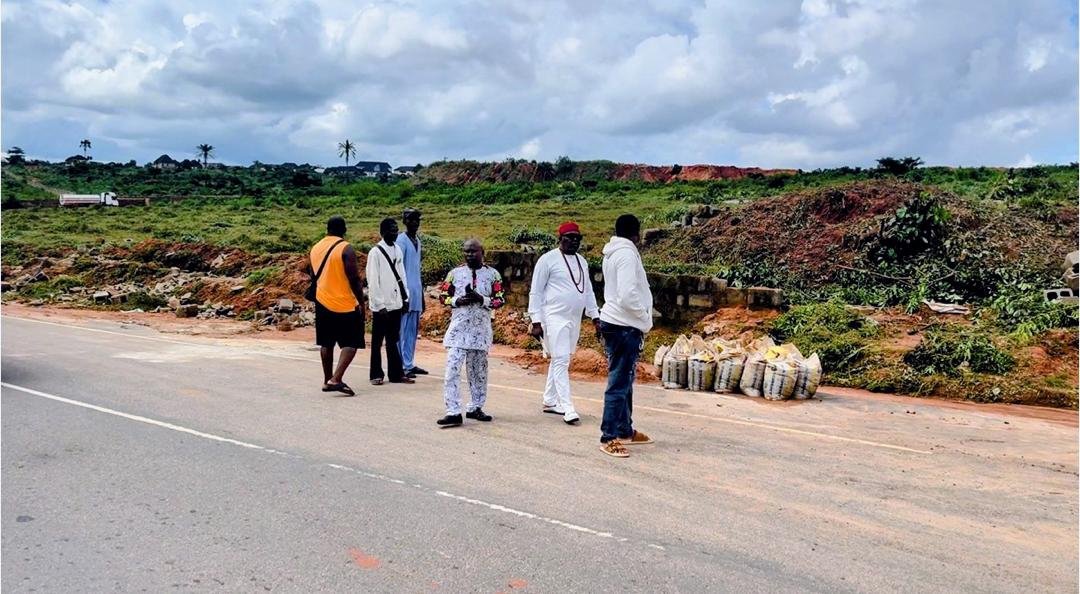
For generations, a parcel of land at the centre of a dispute between Okpanam and the Umuisagba family of Ibusa, in Oshimili North Local Government Area of Delta State, has remained a source of disagreement.
What appears on the surface to be a dispute over ownership has grown into a much deeper contest involving ancestral claims, traditional boundaries, court judgments, government acquisition, survey documents and a sacred shrine.
Both sides insist that they have legitimate claims to the land.
Both sides say legal documents support their positions.
And both sides say they do not want the disagreement to degenerate into violence.
But with the competing claims still unresolved, traditional rulers, community leaders and youths are now calling for government intervention.
At the centre of the controversy is a question that has remained unanswered:
Who legally owns the disputed land?
‘Our brothers, but leave our land’
The Ugoani of Okpanam Kingdom, His Royal Majesty, Dr Michael Mbanefo Ogbolu, described the people of the Umuisagba family of Ibusa, as brothers but accused members of the family of encroaching on what Okpanam considers its territory.
The monarch said the dispute dated back to the 1960s and claimed that Okpanam’s forebears had successfully defended their claim to the land at the Supreme Court.
He said the people of Okpanam had remained peace-loving but would use constitutional means to defend what they believed belonged to them.
“Our brothers from Emesagba community in Ibusa are our brothers, and this matter of the land started way back in the 1960s,” Ogbolu said.
“Our forebears convincingly won that parcel of land at the Supreme Court, and they put it as a mark to demarcate Ibusa from Okpanam. Since then, we have been looking at peace.”
The monarch said the situation had changed after what he described as renewed attempts to claim the disputed area.
“What we want to say as peace-loving people of Okpanam is that we will fight with every available constitutional means to claim what belongs to us,” he said.
He appealed to the people of Ibusa to call their members to order, saying Okpanam could not remain silent while what it considered its territory was being encroached upon.
More than a piece of land
For the people of Okpanam, the dispute is not simply about land.
Community leaders say the disputed area contains a sacred deity known as Aloso Aloka, which they regard as an important spiritual and historical heritage of the kingdom.
The Isagba of Okpanam and Chairman of Ogbodogba Community, Chief Dr Paul Nwayalani, described the land as sacred ancestral property.
He said the history of the dispute dated back to 1962 and alleged that the Umuisagba family of Ibusa, had lost previous legal battles over the land.
According to him, the matter had passed through different levels of the courts, including the High Court, Court of Appeal and Supreme Court.
“There is a sacred deity there which we call Aloso Aloka. A lot of people have lost their lives fighting over this land, and that is why we are very concerned,” Nwayalani said.
He appealed to security agencies and the state government to intervene before the disagreement resulted in violence.
“We cannot afford to send people to go and fight them. We don’t want to use force. But if this continues, the law may take its course, and somebody may die. That is not what we want,” he said.
‘Leave the deity alone’
The Chief Priest of Okpanam Kingdom, Chief Alfred Abua Ntoka, also appealed for the disputed area and the sacred site to be left undisturbed.
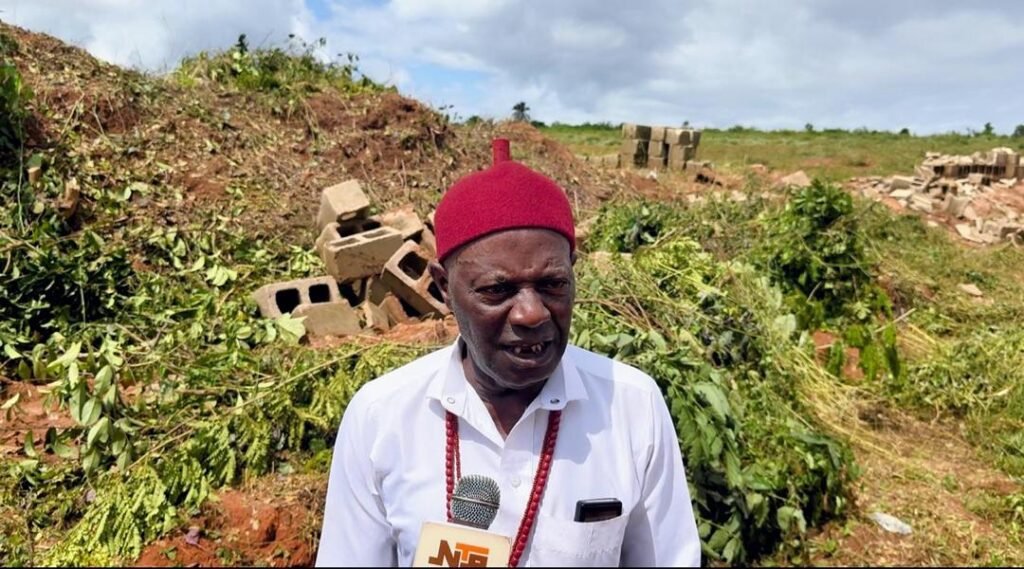
Ntoka expressed concern over what he described as attempts to interfere with the community’s deity.
“We are begging the state government and the public to advise them. They should withdraw from that place and leave the deity as it was,” he said.
He added, “They should leave that place and leave the deity alone because it is not theirs. The deity belongs to Okpanam.”
Youths fear bloodshed
The Chairman of Ogbodogba Community Youth, Chukwuma Abamuyor, said the dispute had existed for many years and that the youths did not want it to result in bloodshed.
Abamuyor claimed that a Supreme Court judgment supported Okpanam’s position on the disputed land.
“We have been battling this issue with the Ibusa people for a very long time, but we don’t want any casualty,” he said.
He appealed to the Delta State Government and Governor Sheriff Oborevwori to intervene.
“We are pleading on behalf of the community with the Delta State Government and His Excellency, the Governor, to come to our aid and see the issue we are currently facing,” he said.
The youth leader also alleged that security personnel had been deployed to the disputed area, creating tension among members of the community.
He urged the government to examine the relevant court judgment, survey plans and other official records to establish the boundaries between the two sides.
“We don’t want to fight over our land. That is why we are appealing to the government,” Abamuyor said.
The Umuisagba family responds
While the Okpanam representatives presented their claims, the Umuisagba family of Ibusa, offered a sharply different account.
Speaking on behalf of the Umuisagba family, their attorney, Peter Udeze, rejected the allegations of encroachment and insisted that the family also possessed legal documents supporting its claim to the disputed land.
Udeze said the land dispute was much older than the period cited by the Okpanam representatives, claiming that litigation over the land dated back to 1914.
He said the information presented by the Okpanam representatives did not reflect the position of the Umuisagba family.
“The information they gave you is wrong. Those places, even up to the back of the post office, belong to our family. This litigation started in 1914,” Udeze said.
According to him, the land claimed by the Umuisagba family extends to the expressway and beyond.
He insisted that the issue should be determined by examining the legal documents held by both sides.
“They have their own Supreme Court judgment and we have our own judgment,” he said.
“If they are saying the land belongs to them, let them provide the proof. Let them produce their court judgment and other documents that establish their ownership of the land.”
Two sides, two Supreme Court claims
Perhaps the most significant development in the dispute is the claim by both sides that they possess Supreme Court judgments supporting their positions.
The Okpanam representatives referred to judgments dating back to the 1960s, while Udeze, speaking for the Umuisagba family, insisted that his family also had a Supreme Court judgment.
Rather than settle the dispute, the competing claims have created another question:
Are the two sides relying on different cases, different parcels of land, or different interpretations of existing judgments?
Udeze said the answer could only be established by bringing the documents together.
“Let everybody bring their documents and let the lawyers interpret them,” he said.
“It is not by physical fighting. We cannot fight. We will follow the legal process.”
He urged the relevant authorities to examine the court judgments, survey plans, maps and government records before determining the boundaries.
The battle over government records
Speaking on behalf of the Umuisagba family, Udeze said the family had written several letters to the Delta State Government, the Ministry of Lands and the Surveyor-General’s office concerning portions of land which it alleged had been wrongly attributed to another community.
He said copies of the correspondence and other documents could be made available for verification.
“We have written to the Governor and the Ministry of Lands, telling them that those places belong to us,” he said.
“We have written to the Surveyor-General and other relevant authorities. We went to the Ministry of Lands to report that they were encroaching on our land.”
Udeze also claimed that the Surveyor-General’s office was considering bringing representatives of the two communities together with their documents to help resolve the matter.
He questioned how some government officials could rely on claims that a party possessed a Supreme Court judgment without first examining the judgment.
According to him, when he asked whether some officials had seen the judgment allegedly relied upon, he was told they had not.
“If you are told that somebody has a Supreme Court judgment, ask them to bring it,” he said.
‘It is not by physical fighting’
Despite the strength of the disagreement, Udeze said the Umuisagba family did not want to settle the matter through confrontation.
He insisted that the family would pursue the dispute through legal and administrative channels.
“It is not done that way. We need to follow it up through litigation,” he said.
Udeze urged both sides to present their documents and allow lawyers and the relevant authorities to interpret them.
“Let the two communities bring their documents. Let the lawyers interpret them and let the appropriate government authorities determine the boundaries,” he said.
He also rejected the suggestion that occupying or developing disputed land automatically established ownership.
“It is not by going to the media to say that you own a property. When you present the document that backs your claim, then you can establish ownership,” he said.
“If you build on somebody’s land, there is no guarantee that the construction gives you ownership of the land.”
A dispute that refuses to disappear
The land dispute has clearly moved beyond a disagreement between individuals.
It now involves traditional institutions, community leaders, youths, family representatives, lawyers, government land authorities and security agencies.
For Okpanam, the land represents ancestral property and includes a sacred shrine that the community says must be protected.
For the Umuisagba family of Ibusa, the same area is land the family says it can establish ownership of through historical and legal records.
The competing narratives are strikingly similar in one respect: both sides believe the land belongs to them.
Both sides also say they have documents.
That makes the role of the government particularly important.
The documents should speak
At this stage, the safest path may be the least emotional one.
The relevant court judgments should be obtained.
The judgments should be carefully interpreted by competent lawyers.
Official survey plans and maps should be examined.
Government acquisition records, gazettes, compensation records and other relevant documents should be reviewed where applicable.
Most importantly, the authorities should determine whether the documents being cited by both sides refer to the same parcel of land.
If they do, the legal implications should be clearly established.
If they refer to different parcels, the boundaries should be clearly identified.
And if there are conflicting interpretations, the appropriate legal avenue should be followed.
A plea for peace
The most worrying aspect of the dispute is not the disagreement itself.
It is what could happen if the disagreement moves from the courtroom and government offices into the streets.
The Okpanam monarch has appealed for peace.
The Isagba has warned against bloodshed.
The chief priest has appealed for the protection of the shrine.
The youth chairman has urged government intervention.
And Peter Udeze, speaking for the Umuisagba family of Ibusa, has also insisted that his family wants the matter handled through legal channels rather than physical confrontation.
That shared position offers a possible way forward.
The two sides may disagree over history, boundaries and ownership, but they appear to agree that violence is not the answer.
Government has an opportunity
The Delta State Government now has an opportunity to prevent the dispute from becoming a larger community crisis.
A transparent process that brings representatives of Okpanam and the Umuisagba family together, alongside officials from the Ministry of Lands, the Surveyor-General’s office, legal representatives and independent survey experts, could help establish the facts.
The objective should not be to give one side a political victory.
It should be to establish the truth from the records and ensure that whatever decision is reached is respected by all parties.
For a dispute that has reportedly lasted for generations, another generation should not have to inherit it.
The missing voices
Efforts were made to obtain the response of the Umuisagba family of Ibusa, to the allegations made by the Okpanam monarch, chiefs and youth leaders.
However, the family could not be reached directly for comment as of the time of filing this report.
The response attributed to the Umuisagba side in this report was provided by Peter Udeze, who identified himself as the attorney speaking on behalf of the Umuisagba family of Ibusa.
His account represents the position of the Umuisagba family and has been presented as such.
For now, the land remains disputed.
The shrines remain part of the argument.
The court judgments remain central to the claims.
And two communities continue to look at the same stretch of land through very different historical and legal lenses.
But beneath the arguments over ownership is a more urgent question:
Will the land become a reason for another generation to fight, or an opportunity for two communities to finally settle an old dispute through truth, law and dialogue?
The answer lies not in confrontation, but in the documents, the law and the willingness of both sides to accept a fair resolution.
For Okpanam and the Umuisagba family of Ibusa, the greatest victory would not be seeing the other side defeated.
It would be seeing the dispute finally settled—and peace preserved.