


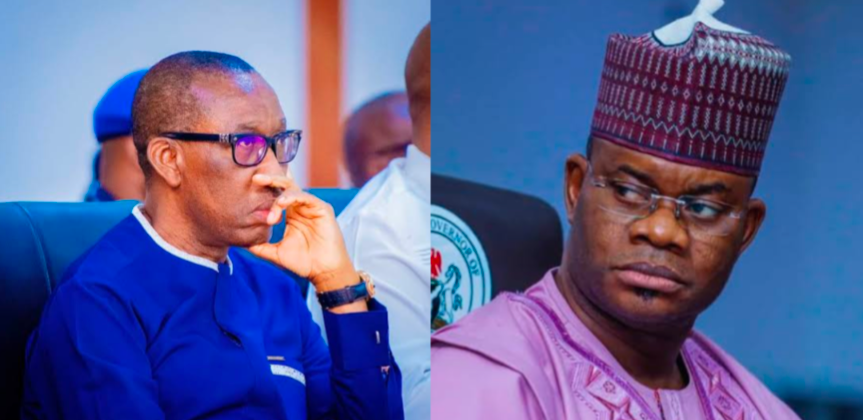
The Human Rights Writers Association of Nigeria has asked the Economic and Financial Crimes Commission to clarify the status of its investigations into former Delta State Governor Ifeanyi Okowa and former Kogi State Governor Yahaya Bello, urging it to prosecute them if sufficient evidence exists.
HURIWA’s National Coordinator, Emmanuel Onwubiko, made the call in a statement on Friday, saying the anti-graft agency should not leave the cases unresolved indefinitely.
“Where investigators have sufficient evidence to prosecute, the EFCC should proceed without undue delay. Where the evidence is insufficient, the commission should equally clarify the position rather than leave the matter indefinitely unresolved,” the association said.
Okowa was arrested in November 2024 over allegations relating to the management of funds during his eight-year tenure as Delta governor, according to reports cited by HURIWA.
The allegations included questions about the N1.3tn 13 per cent derivation fund from the Federation Account between 2015 and 2023, as well as funds allegedly used to acquire shares in a floating liquefied natural gas project and other investments.
HURIWA stressed that the allegations did not amount to proof of guilt, noting that Okowa had denied wrongdoing.
The association also urged the EFCC to provide clarity on its investigation into Bello over the alleged diversion of public funds during his tenure as Kogi governor.
It called for both cases to be handled transparently and through due process, stressing that neither former governor should be presumed guilty without a court determination or shielded from investigation because of political affiliation.
“Nigerians should not have to choose between respect for the presumption of innocence and the demand for accountability from public officials,” HURIWA said.
The association also urged the All Progressives Congress to explain the rationale behind its reported senatorial choice in Delta North and called on the Independent National Electoral Commission to apply electoral laws impartially.
It said questions of electoral eligibility should be determined by relevant constitutional and statutory provisions, not public allegations alone.