


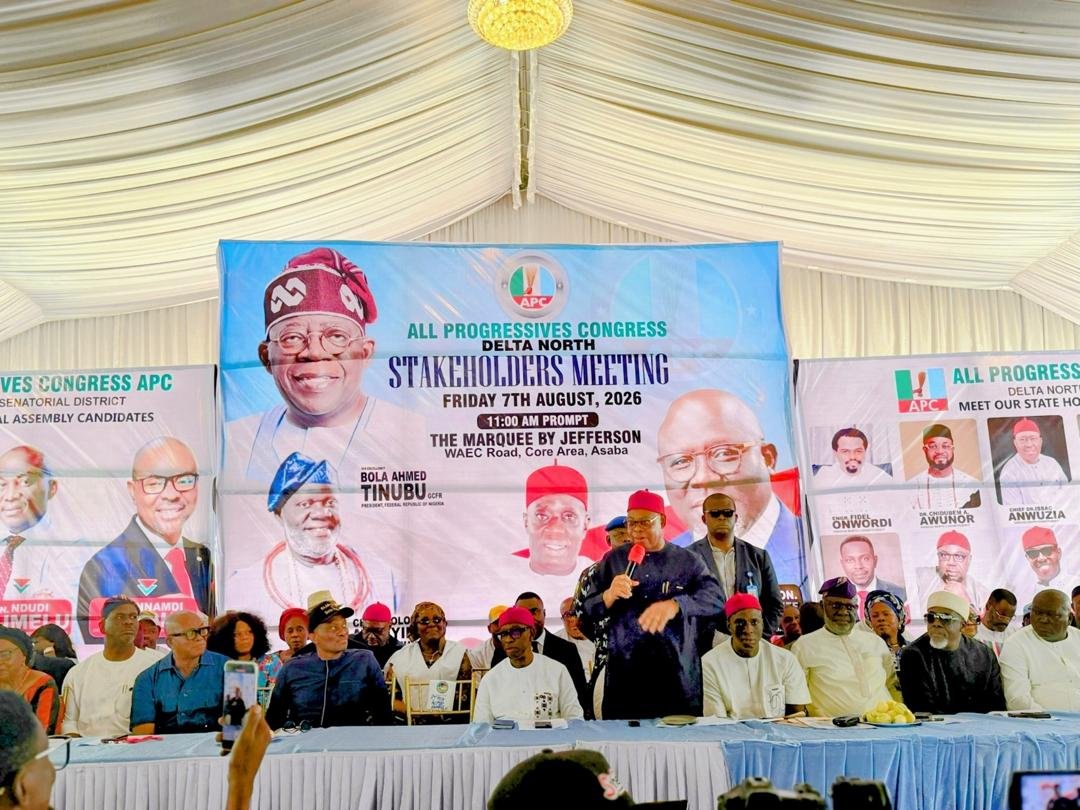
The All Progressives Congress in Delta North has begun a fresh effort to unite its members and rebuild its grassroots structures ahead of the 2027 general elections, with party leaders calling on aspirants who lost the recent primaries and congresses to put their differences aside and work for the party’s success.
The call was made on Friday, August 7, 2026, during a stakeholders’ meeting held at The Marquee by Jefferson Hall on WAEC Road, Asaba, where the party brought together its major leaders, elected representatives and grassroots officials across the nine local government areas of Delta North.
The meeting was attended by the APC State Chairman, Chief Solomon Arenyinka; Deputy Governor, Sir Monday Onyeame; former Delta State Governor and Delta North senatorial candidate, Senator Ifeanyi Okowa; former House of Representatives Minority Leader, Hon. Ndudi Elumelu; members of the Delta State House of Assembly from the district; commissioners; the nine local government chairmen; councillors; local government and ward party chairmen and other party members.
Rather than concentrating only on the outcome of the primaries, the meeting focused heavily on how the party could heal internal divisions and reconnect with members at the grassroots.
The Delta North APC Chairman, Engr. Daniel Ossai, said the party had gone through difficult political processes but had a responsibility to move beyond them.
He congratulated the candidates produced by the party and urged them not to see the primaries as the end of the political contest.
Ossai also appealed to aspirants who were unsuccessful to remain committed to the APC, stressing that political opportunities would come at different times.
He urged successful candidates to extend a hand of fellowship to their former opponents and work with them rather than treating them as defeated members.
According to him, the APC would need unity, loyalty and hard work to confront its political opponents in 2027.
The Delta North chairman disclosed that reconciliation committees had been established to address grievances arising from the congresses and primaries.
He said the committees had already started producing results, with some aggrieved members returning to the party’s activities after discussions with party leaders.
Local chairmen report progress
The reconciliation message was supported by several local government chairmen who gave updates on the situation in their respective areas.
The APC chairman in Aniocha South, Norbert Akachukwu Sochukwudinma, said the local government had established a reconciliation committee after the primaries to engage aspirants and members who were dissatisfied with the outcome.
He said the aspirants who contested the House of Assembly primary remained members of the APC and had expressed their willingness to work for the party.
Similarly, the Ika North-East APC chairman, Asiwe Emeka, said former aggrieved members had begun returning to party activities.
He attributed the development to the reconciliation efforts by party leaders and said the unity achieved so far would make mobilisation easier ahead of the elections.
The Ika South APC chairman, Comrade Frank Chukwueku, also highlighted the ward-to-ward meetings organised in his local government.
He said the exercise allowed party leaders to meet members directly, hear their concerns and address some of their problems.
According to him, the party also set up a reconciliation committee to resolve outstanding issues.
The various reports suggested that the APC leadership was attempting to move reconciliation beyond political speeches by taking the process to local government and ward levels.
“Your unit is your power”
The APC State Chairman, Chief Solomon Arenyinka, reinforced the need for the party to return to its grassroots structure.
He told party leaders that political strength begins at the unit level and urged them to attend meetings in their wards and units.
Arenyinka warned against a situation where political leaders would operate mainly at the state level while neglecting the structures that produced them.
He described the unit as a politician’s foundation and urged members to begin their mobilisation from there.
The chairman also called for more inclusive leadership, saying party members should be allowed to participate in decision-making at the local government level.
He said the party would continue to encourage consultation among leaders rather than allowing individual interests to dominate the affairs of local governments.
Okowa rejects rally-driven campaign
Former Delta State Governor, Senator Ifeanyi Okowa, took the grassroots strategy further by urging APC candidates to rethink the way political campaigns are conducted.
Okowa said large rallies alone could no longer guarantee victory because they often attract people who are already supporters of the party.
He encouraged candidates to engage voters in smaller groups, listen to their concerns and explain their programmes directly to them.
According to him, the APC should take its campaign to the units and communities, where candidates would have the opportunity to interact with voters who may not attend major political rallies.
He urged party members to reach out to churches, market associations, youth groups, transport workers, women and other community organisations.
Okowa also called for greater inclusion of members who lost positions during the recent congresses, particularly former ward and local government executives.
He said reconciliation should not be limited to aspirants who lost primaries but should also include party members who lost their positions during the congresses.
He urged local government and ward chairmen to deliberately bring such members back into the party structure.
Women, youths urged to take their place
The question of inclusion also featured prominently during the meeting.
Arenyinka expressed concern about the limited participation of women at the stakeholders’ gathering and urged party leaders to create more opportunities for women to participate actively in APC affairs.
Okowa also stressed the importance of women and youths in the 2027 elections.
He said the party must recognise that political mobilisation was changing and that young people, women and other groups could not be ignored.
He urged leaders to go beyond the traditional party structures and engage people in their communities.
Tinubu, Oborevwori endorsed
The meeting also produced a major political resolution when former House of Representatives Minority Leader and Aniocha/Oshimili constituency candidate, Hon. Ndudi Elumelu, moved a motion endorsing President Bola Tinubu as the APC’s sole presidential candidate for the 2027 election.
He also moved for the endorsement of Delta State Governor, Sheriff Oborevwori, as the party’s preferred candidate for the governorship election.
Elumelu said the decision was based on what he described as the President’s support for Delta State and the governor’s performance in office.
He praised Oborevwori for maintaining a cordial relationship with his predecessor, Senator Okowa, describing the relationship as an example of political cooperation.
Elumelu said the state had benefited from the cooperation between the Federal Government and the Delta State Government and urged APC members to support both leaders.
The motion was seconded by Rt. Hon. Frank Ngozi Esenwa, who represents Oshimili North in the Delta State House of Assembly.
Arenyinka subsequently subjected the motion to a voice vote, and the stakeholders endorsed it.
The endorsement gave the meeting a broader political significance beyond its original focus on reconciliation.
It showed that the Delta North APC leadership was attempting to establish a common political direction ahead of the 2027 elections.
From reconciliation to mobilisation
The speeches at the meeting repeatedly returned to one issue: reconciliation would only be meaningful if it produced political mobilisation.
The APC leaders acknowledged that the party had disagreements during the congresses and primaries, but they argued that continuing those battles could weaken the party before the general elections.
Deputy Governor Sir Monday Onyeame urged party members to come together and reach out to those who did not get what they wanted during the recent internal contests.
He said the party needed everyone to move forward as one.
For the local government chairmen, the immediate task is now to take the message from Asaba back to the wards and units.
The party’s challenge will be to ensure that members who returned after the reconciliation process remain active and that those who are still unhappy are not left behind.
The meeting therefore ended with a political task rather than simply a celebration.
The APC must now translate its resolutions into action.
Its candidates must work with those who contested against them. Local government chairmen must strengthen their structures. Ward and unit leaders must reconnect with members, while the party leadership must continue addressing grievances.
For the Delta North APC, the road to 2027 is no longer just about choosing candidates.
The party has chosen its candidates and declared its preferred presidential and governorship options. Its bigger challenge now is to keep its political family together long enough to turn those choices into electoral victories.
The Asaba meeting may therefore be remembered less for the speeches delivered inside the hall and more for what happens after the politicians return to their communities.
If the reconciliation continues at the grassroots and the party succeeds in turning its units, wards and local governments into active campaign structures, the APC will have laid an important foundation for its 2027 campaign.
But if old grievances return after the applause has faded, the unity displayed at the meeting could prove difficult to sustain.
For now, the message from Delta North APC is clear: the primaries are over, reconciliation has begun, and the party wants its members back on the same side before the real battle for 2027 begins.