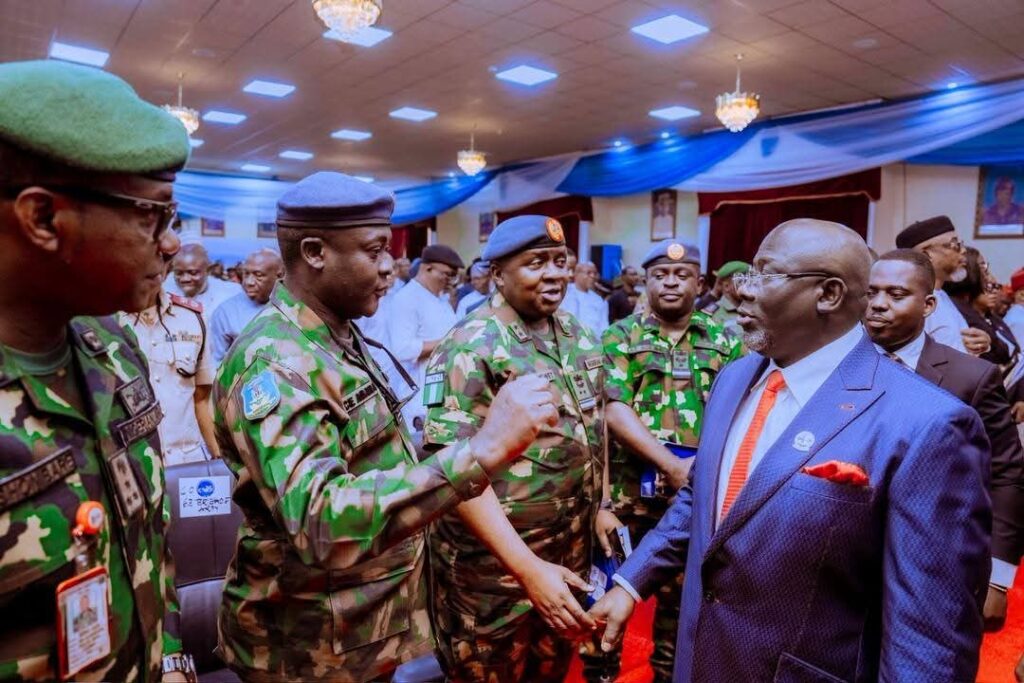


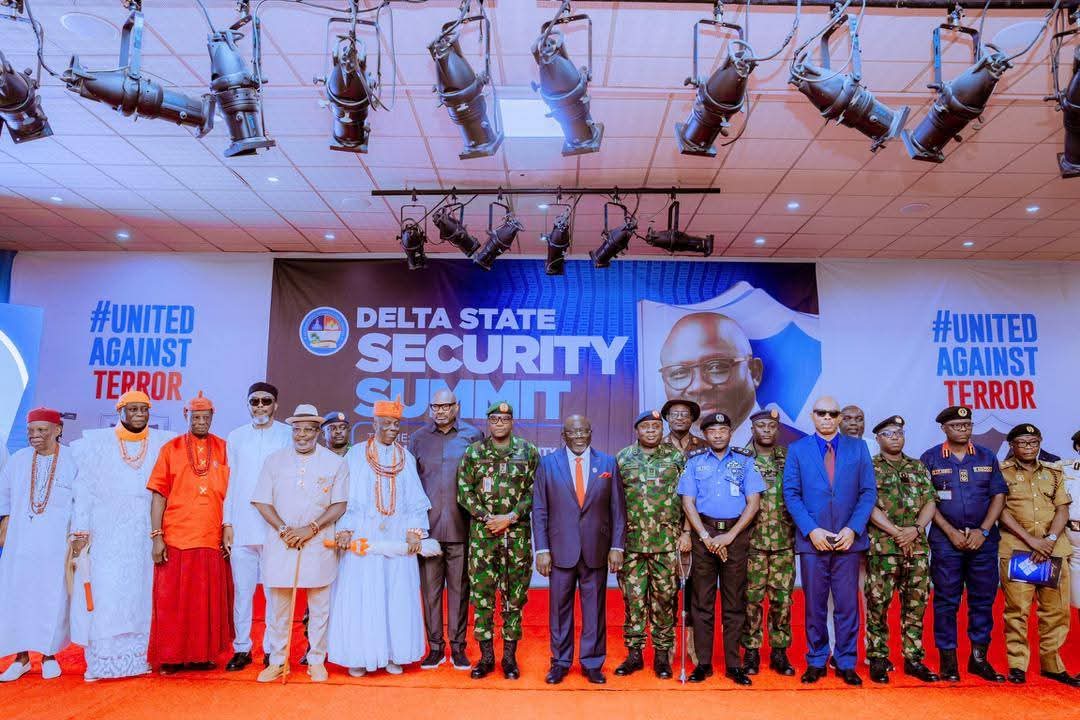
Security stakeholders in Delta State on Tuesday agreed that tackling insecurity requires active participation from communities, warning that government and security agencies alone cannot effectively secure the state.
The resolution was reached at a Security Summit held at Unity Hall, Government House, Asaba, which brought together government officials, security chiefs, traditional rulers, and other stakeholders to discuss rising security concerns.
The summit featured presentations from the Commissioner of Police, CP Yemi Oyeniyi; senior military officers including Brigadier General Folu Shonibare; the Secretary to the State Government, Dr Kingsley Emu; and other key actors in the security sector.
Governor Sheriff Oborevwori formally declared the summit open, describing security as the foundation for peace, development, and economic growth in the state.
Governor Oborevwori said the theme of the summit, “Security: A Collective Responsibility,” reflects the reality that modern security challenges cannot be handled by government alone.
He said his administration has continued to support security agencies with logistics, funding, and coordination, but stressed that community involvement remains essential.
“Security agencies are not magicians. They rely heavily on information from the people. If you see something, say something,” he said.
The governor added that the state has strengthened joint security operations, established operational bases across local government areas, and launched the Delta Security Trust Fund.
He also disclosed ongoing efforts to procure vehicles and communication equipment to improve response to security threats.

Military representatives, including Air Vice Marshal Edward Gabkwet, Brigadier General Folu Shonibare, and Commodore Shehu Tasiu, praised the Delta State Government’s security initiatives.
They said effective security depends on three key pillars: government, security agencies, and the people.
Brigadier General Shonibare particularly commended Governor Oborevwori’s swift intervention in recent tensions in Warri, noting that it helped prevent escalation.
He also said improved collaboration among stakeholders has contributed to a reduction in violent crimes and kidnapping cases in the state.
The security chiefs emphasised that timely intelligence from citizens remains critical to effective policing.
Delta State Commissioner of Police, CP Yemi Oyeniyi, said Nigeria’s security challenges require what he described as a “whole-of-society approach.”
He listed kidnapping, cultism, cybercrime, pipeline vandalism, oil theft, drug trafficking, and communal clashes as major threats.
Oyeniyi stressed that no single agency can handle insecurity alone and called for stronger cooperation among government institutions, security agencies, traditional rulers, religious leaders, the private sector, and citizens.
The Asagba of Asaba, HRM Prof. Epiphany Azinge (SAN), raised concern over the movement of unknown persons into communities without proper monitoring.
He said intelligence gathering must be strengthened at the grassroots level to improve security.
“We must know who lives in our communities. Suspicious movements must be properly monitored,” he said.
He also called for stronger use of technology such as drones, improved forest surveillance, and emergency response hotlines.
Secretary to the State Government, Dr Kingsley Emu, announced that the state is intensifying security reforms, including full implementation of the Vigilante Law and the creation of Forest Guards.
He said many criminals now use forests as hideouts, making it necessary to secure such areas.
Emu also called for the use of modern technology in policing and directed local government councils to hold regular security meetings and submit reports.
The Orodje of Okpe, HRM Maj. Gen. Felix Mujakperuo (Rtd), stressed the need for proper screening of vigilante members before deployment.
He said communities should select candidates, who must then be vetted by traditional rulers, the police, and the DSS before being issued identification.
He warned that anyone without proper identification should not operate as a vigilante.
He added that vigilantes remain essential, especially in rural areas where formal security presence is limited.
Across the summit, participants agreed that insecurity thrives where information is not shared.
They urged citizens to report suspicious activities promptly and support security agencies with credible intelligence.
They also called for stronger collaboration among communities, local governments, and security operatives.
At the end of the summit, stakeholders reaffirmed that lasting security in Delta State depends on teamwork between government, communities, and security agencies.
They pledged to strengthen intelligence sharing, improve coordination, and expand community-based security structures.
Governor Oborevwori expressed confidence that the resolutions reached would contribute significantly to peace and stability across the state.