


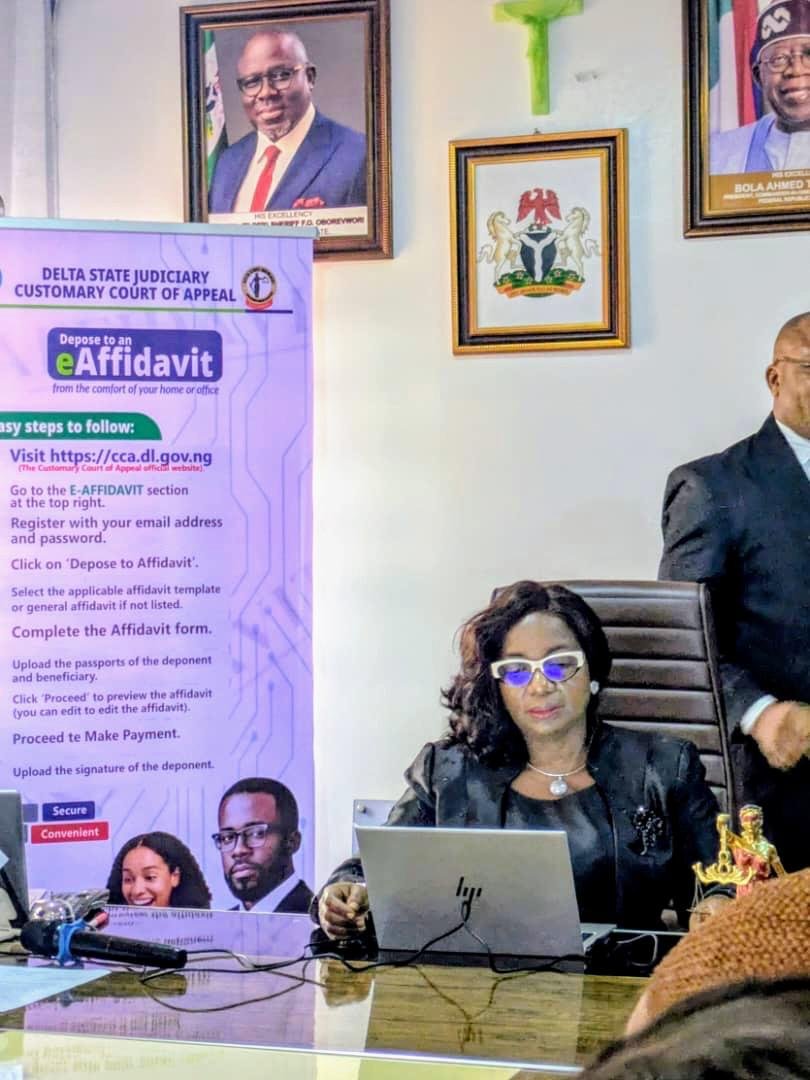
The Delta State Customary Court of Appeal has introduced an online affidavit system that allows members of the public to obtain approved affidavits without visiting court premises.
The court also disclosed plans to introduce electronic filing of appeals as part of efforts to reduce delays, simplify judicial procedures and improve access to justice.
The President of the court, Justice C.N. Ojugbana-Orishedere, announced the development on Thursday during the launch of the Electronic Affidavit System at the court’s headquarters in Asaba.
Ojugbana-Orishedere said the platform would eliminate repeated physical visits to court, reduce paperwork and make the process of obtaining affidavits faster and more convenient.
She explained that the portal, accessible through https://cca.dl.gov.ng, allows applicants to register, select affidavit templates, provide necessary information, upload supporting documents and signatures, generate documents for preview and make prescribed payments online.
According to her, the platform was developed under the Delta State Customary Court of Appeal Court Management Information System, known as DeltaCCACOMIS.
She said, “Traditionally, obtaining an affidavit has often involved physical visits to court premises, manual preparation of documents, movement between offices and other administrative procedures that may consume valuable time.
“But with the introduction of this platform, many of these processes can now be initiated and completed electronically.”
The judge explained that applicants would be required to upload their signatures during registration, subject to approval by the Commissioner for Oaths before the affidavit could be printed.
She added that the system also contained a Quick Response code to enable users to verify the authenticity of issued affidavits.
To demonstrate its operation, the court president conducted a live test of the portal during the ceremony by logging in and initiating an affidavit application.
She said the digital initiative was not designed to replace judicial officers or administrative workers but to strengthen the court’s capacity and improve service delivery.
“The ultimate objective is not merely to digitise documents or introduce electronic platforms. It is to make justice administration more responsive to the needs of the people, reduce avoidable delays and strengthen public confidence in the Judiciary,” she said.
On the planned electronic filing of appeals, Ojugbana-Orishedere said the system would enable cases to be initiated, processed, managed and tracked digitally, thereby simplifying court procedures.
She urged lawyers, court users and members of the public to embrace the innovation, while calling on judicial officers and administrative staff to demonstrate professionalism and commitment to its successful implementation.
The Attorney-General and Commissioner for Justice, Ekemejero Ohwovoriole, SAN, represented by the Director of Law, Research, Review and Publication, Ben Ijeoma Adigwe, described the initiative as a step towards aligning Delta State’s justice delivery system with global technological developments.
He said the platform would make judicial services more accessible, convenient and efficient for lawyers and members of the public.
The commissioner also pledged the ministry’s continued cooperation and support for the initiative and subsequent phases of the court’s digital transformation programme.
Similarly, the Chairman of the Nigerian Bar Association, Asaba Branch, Richard Ogbolu Okonyia, described the launch as a significant milestone in the administration of justice in the state.
Okonyia said the platform would reduce administrative bottlenecks and delays associated with obtaining affidavits.
“We are confident that the affidavit portal will reduce administrative bottlenecks, promote timely service delivery, minimise unnecessary physical processes and further strengthen public confidence in the justice system,” he said.
He reaffirmed the branch’s commitment to supporting reforms aimed at improving court administration and making the justice system more accessible through technology.
The court president commended Governor Sheriff Oborevwori for his support for the administration of justice in the state.
She also appreciated the technical team, system developers and other professionals who contributed to the development of the platform before formally declaring it open for use.