


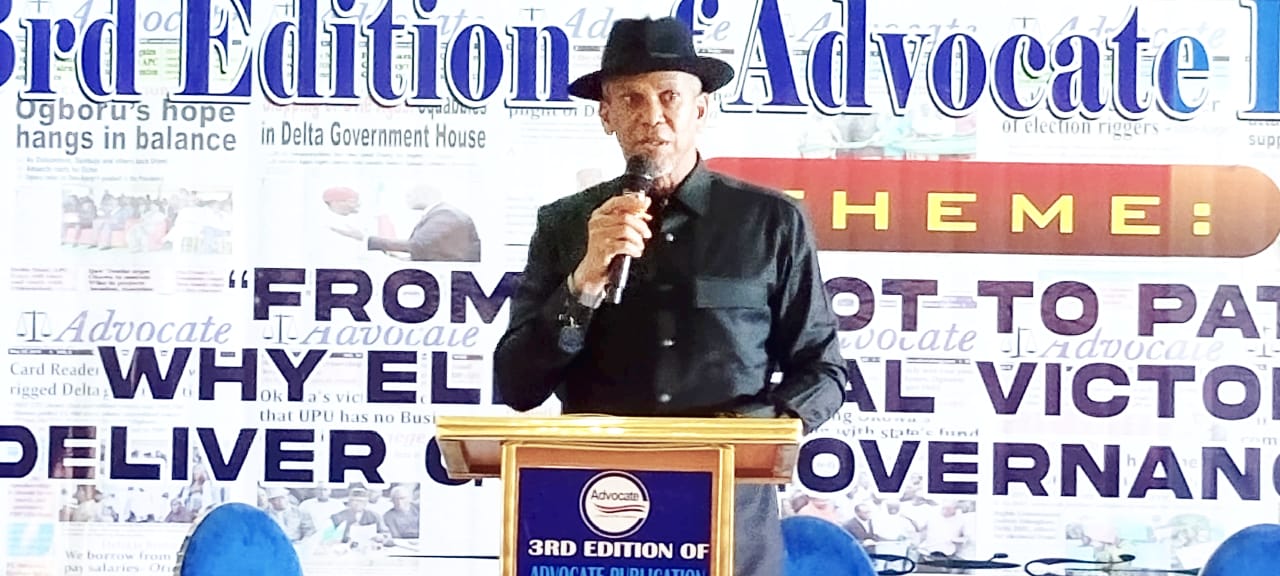
Ughelli, Delta State — Senator Ede Dafinone has called on Nigeria’s political class to move beyond rhetoric and embrace practical solutions to the country’s governance challenges, warning that electoral victories must translate into meaningful improvements in citizens’ lives.
The lawmaker made this appeal during the 3rd Advocate Lecture Series organised by Advocate Publication Ltd, publishers of Advocate Newspaper. The event, held at Wetland Hotel, brought together key stakeholders from political, academic, and civic circles.
Themed “From Ballot to Patronage: Why Electoral Victory Fails to Deliver Good Governance in Nigeria,” the lecture explored the persistent gap between winning elections and achieving effective governance.
In his remarks, Senator Dafinone stressed the importance of shifting national conversations from identifying problems to implementing solutions.
“It is easy to talk about what is wrong,” he said, “but far more important to focus on how we can fix it.”
He noted that while discussions about governance failures are common, what Nigeria urgently needs is actionable reform, especially as the country prepares for the 2027 general elections.
Addressing concerns over the possibility of Nigeria drifting toward a one-party system, Dafinone downplayed such fears. According to him, political defections to ruling parties are a recurring trend in Nigeria’s democratic history since 1999.
He explained that such movements are typical during mid-term political cycles and should not necessarily be interpreted as a threat to democratic plurality.
Reflecting on the 2023 general elections, the senator acknowledged improvements in voter awareness and electoral credibility. However, he pointed out that vote-buying remains a major concern.
According to him, the practice stems from a deeper issue—many Nigerians feel their votes do not truly count, undermining confidence in the democratic process.
Dafinone also defended recent economic policies, particularly the removal of fuel subsidies, describing them as difficult but essential steps.
He argued that past administrations avoided such decisions for fear of losing popularity, while the current government has chosen a more challenging path in pursuit of long-term stability.
“The benefits will come,” he assured, urging Nigerians to remain patient despite current economic hardships.
In the keynote address, development expert Charles Apoki delivered a critical assessment of Nigeria’s democratic system, arguing that citizens have largely lost control over governance.
“That is not democracy,” Apoki said. “The people do not own the government.”
He attributed this disconnect to political ignorance and the widespread practice of vote-selling, where citizens exchange their electoral rights for short-term financial gain.
Apoki further criticised the high cost of political participation, describing it as a major barrier to credible leadership.
He noted that many politicians, after spending heavily to win elections, often prioritise recouping their investments instead of serving the public. This, he said, fuels the dominance of political “godfathers” and weakens accountability.
Earlier, the Chief Executive Officer of Advocate Publication Ltd, Shedrack Onitsha, explained that the lecture’s theme was chosen to address the disconnect between electoral success and governance outcomes.
“Governments come with promises, but at the end, there is little to show,” he said.
The event featured panel discussions and goodwill messages from prominent figures, including Sheriff Oborevwori, who was represented at the gathering.
Participants collectively called for comprehensive reforms aimed at strengthening democratic institutions, reducing the cost of politics, and ensuring that governance delivers tangible benefits to Nigerians.
As Nigeria looks toward 2027, the consensus at the forum was clear: electoral victory alone is not enough—what truly matters is translating mandates into measurable progress for the people.