


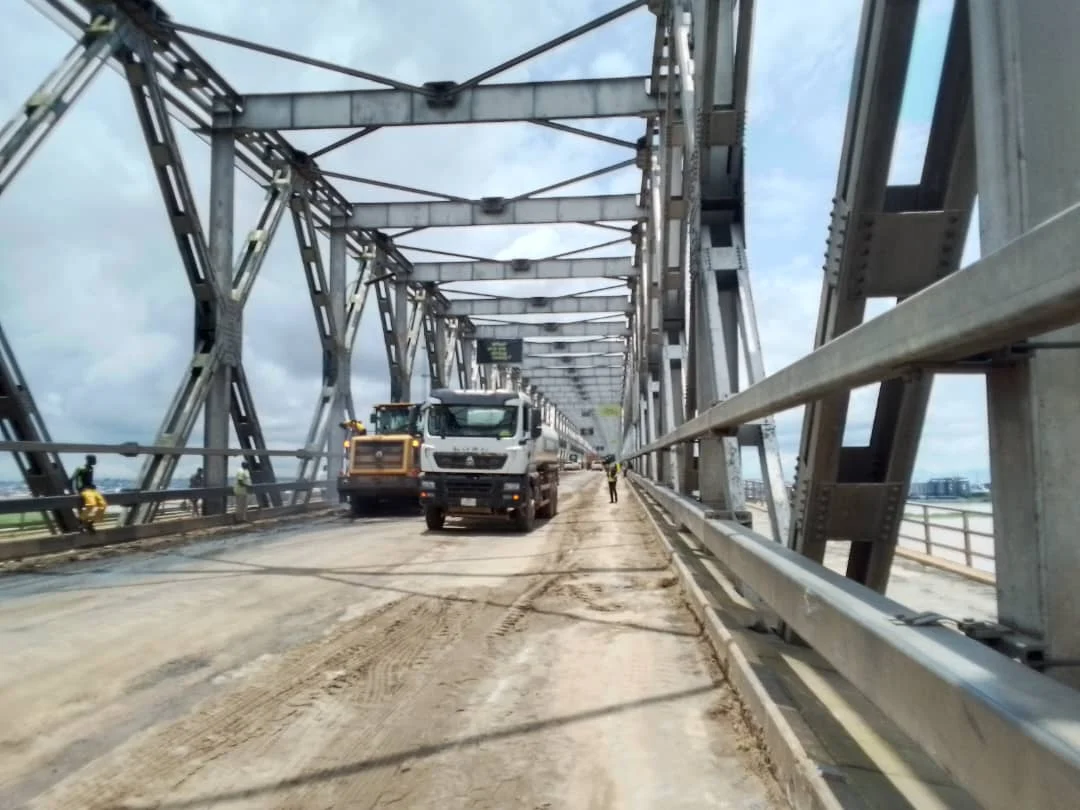
The reopening of the First Niger Bridge linking Onitsha, Anambra State, and Asaba, Delta State, has been delayed by one week following persistent rainfall that disrupted rehabilitation work on the bridge.
The Federal Ministry of Works had scheduled the reopening for Monday, September 21, 2026, after closing the bridge on September 7 for emergency repairs.
However, the bridge remained closed on Monday as heavy rain disrupted work at the site, leaving motorists and commuters to contend with prolonged traffic and higher transport fares.
The Acting Federal Controller of Works, Anambra State Field Headquarters, Timothy Emenike, confirmed the extension in a telephone interview with the Punch.
He said the contractor needed at least three consecutive dry days to return to some sections of the bridge affected by the rain.
“We have actually done a lot of work on most portions of the bridge, but with the constant heavy rains for almost one week, some areas have been affected and need at least three dry days for us to return to site,” Emenike said.
He added that the completion period had been extended by one week, subject to favourable weather conditions.
“Once the maintenance work on the bridge is completed, the Minister of Works, Dave Umahi, will undertake another inspection of the project to assess the work and give approval for the reopening of the bridge,” he said.
The bridge was closed to allow the ministry and its contractor to replace vandalised railings, bolts, and nuts; repair portions of the expansion-joint steelwork and stanchion/steel-truss nuts; and install CCTV cameras.
A site engineer, who spoke on condition of anonymity because he was not authorised to speak, said the repairs to the vandalised bolts and nuts had been completed, while work had reached the asphalt stage.
He, however, said repeated rainfall had caused delays and affected the delivery of some materials, including asphalt.
“Each time there is rainfall for a day, the job is delayed for two days or more,” the engineer said.
He also identified inadequate lighting as one of the factors affecting night operations, saying that the safety of workers and materials had to be considered.
The continued closure has increased pressure on alternative routes between Onitsha and Asaba.
The Federal Ministry of Works had advised motorists to use the Second Niger Bridge through Obosi and the Onitsha-Owerri Road towards Asaba and other destinations.
However, commuters using the alternative routes have complained of long delays and increased transport fares.
A motorist, Uchenna Orji, said the alternative routes had become heavily congested and were in poor condition.
He urged the authorities to improve the alternative routes whenever major bridges were closed for rehabilitation.
A trader, Nkiruka Ozo, said commuters now spent more than three hours on a journey that ordinarily took less than 45 minutes.
“Apart from that, the transportation cost has more than tripled, thereby extending the hardship on motorists. We urge the authorities concerned to speed up the work,” she said.
The ministry said the bridge would be reopened as soon as the maintenance work was completed and the necessary inspection and approval obtained.