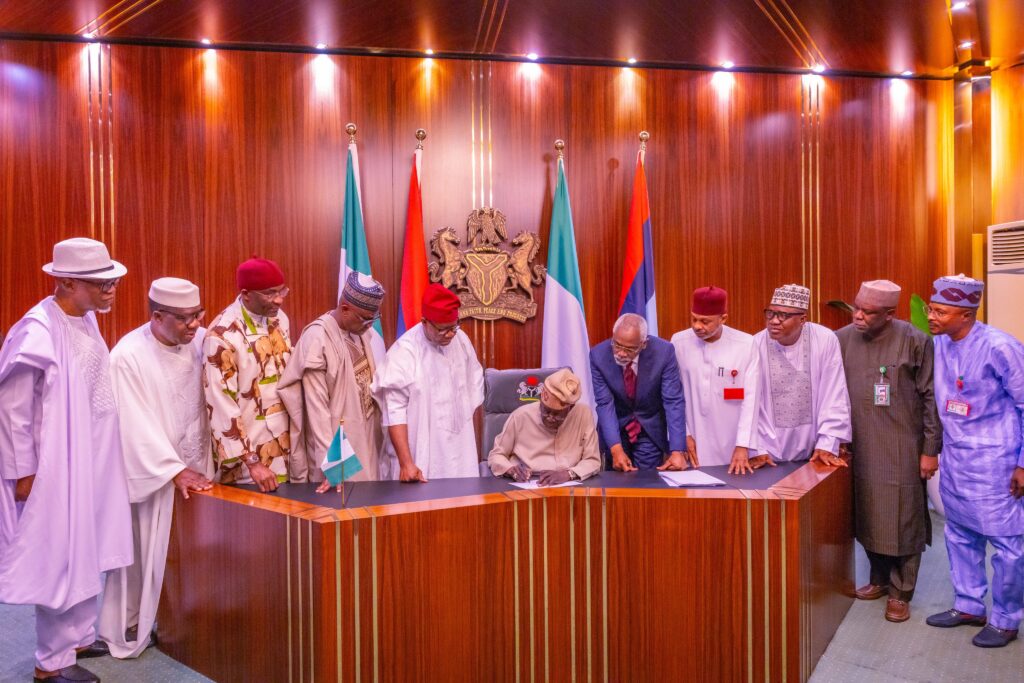


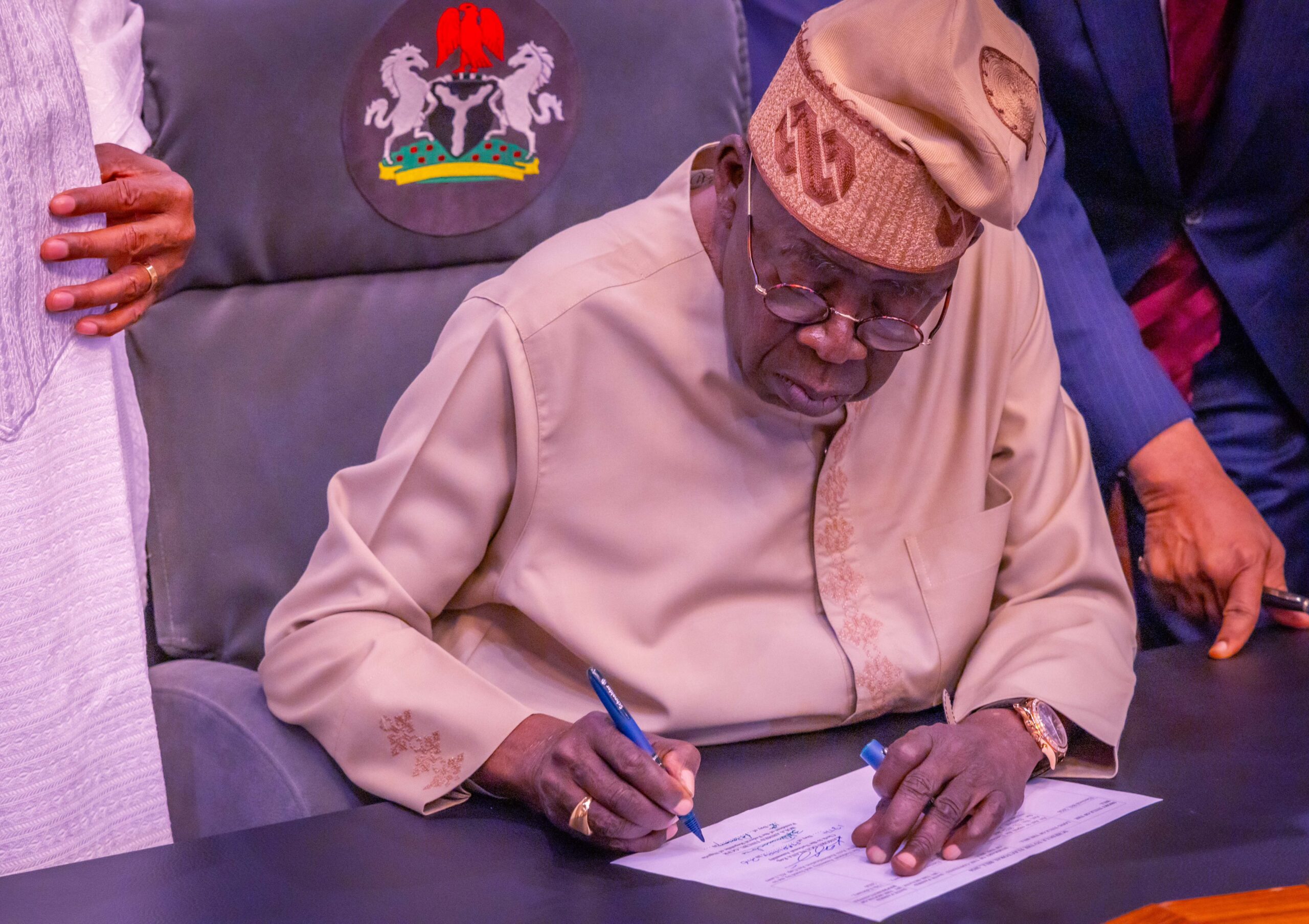
President Bola Ahmed Tinubu has signed the Electoral Act, 2022 (Repeal and Re-Enactment) Bill 2026 into law, introducing fresh changes to Nigeria’s electoral process ahead of the 2027 general elections. The signing follows weeks of intense debate in both chambers of the National Assembly, particularly over how election results should be transmitted.
The new law replaces aspects of the 2022 Electoral Act and seeks to clarify procedures for voting, counting, and transmitting results. At the centre of the controversy is whether election results should be transmitted electronically in real time or whether manual transmission should remain an option in cases of technical failure.
Tinubu signed the bill on Wednesday at the State House in Abuja in the presence of key government officials, including Senate President Godswill Akpabio, Speaker of the House of Representatives Tajudeen Abbas, and his Chief of Staff, Femi Gbajabiamila. The President described the new law as a step toward strengthening Nigeria’s democracy and restoring public confidence in the electoral system.
Speaking after signing the bill, Tinubu emphasised that democracy thrives on open debate and careful management of electoral processes. He said the goal is to ensure elections are conducted without confusion, voter disenfranchisement, or unnecessary disputes.
According to the President, elections in Nigeria remain fundamentally manual, as voters physically appear at polling units, receive ballot papers, thumbprint their choices, and ballots are counted by hand. He noted that while technology can support the process, the final announcement of results is still made by human officials.
Tinubu also addressed concerns about the electronic transmission of results, urging Nigerians to consider the country’s technological readiness, including broadband capacity. He warned against over-reliance on systems that could be vulnerable to glitches or cyber interference.
“It is the manual result that is primary,” the President said, explaining that electronic transmission serves mainly as a means of relaying already-collated results. He added that safeguards must be put in place to prevent hacking or system failures that could undermine the credibility of elections.
The passage of the bill, however, was marked by dramatic scenes in the Senate. On Tuesday, lawmakers resumed deliberations with disagreement over Clause 60 of the bill, which deals with the transmission of election results.
Senator Enyinnaya Abaribe (ADC, Abia South) demanded a division on Clause 60(3), seeking to remove a provision that allows manual transmission of results if electronic transmission fails. He argued that Form EC8A — the polling unit result sheet — should not be the sole basis in the event of electronic failure without stronger safeguards.
Senate President Akpabio initially suggested that the demand had been withdrawn, but opposition senators immediately objected. Deputy Senate President Barau Jibrin cited procedural rules to argue that it would be out of order to revisit a matter already ruled upon, sparking further tension in the chamber.
The disagreement escalated into a heated exchange, with senators engaging in vocal protests. Senator Sunday Karimi briefly clashed with Abaribe during the debate.
Following a formal division ordered by the Senate President, 55 senators voted in support of retaining the proviso that allows manual transmission in case of network failure, while 15 senators opposed it.
Earlier in the session, the Senate had moved to rescind its previous amendment before dissolving into the Committee of the Whole for clause-by-clause reconsideration of the bill. The process was temporarily halted when Abaribe raised a point of order at Clause 60, prompting consultations and eventually a closed-door session.
The controversy was not limited to the Senate. In the House of Representatives, lawmakers also disagreed over a motion to rescind the earlier passage of the Electoral Act Amendment Bill, which had adopted compulsory real-time electronic transmission of results to the Independent National Electoral Commission’s (INEC) Result Viewing Portal (IReV).
The Chairman of the House Committee on Rules and Business, Francis Waive, moved the motion for rescission to align the House with the Senate’s position. When Speaker Tajudeen Abbas put the motion to a voice vote, the “nays” appeared louder than the “ayes,” but he ruled in favour of the motion. This decision triggered protests from some lawmakers, leading to an executive session.
With the President’s assent, the new Electoral Act now becomes the legal framework guiding the conduct of elections in Nigeria. The law is expected to shape preparations for the 2027 polls, especially regarding the balance between manual voting procedures and electronic transmission of results.
Political observers say the real test will come during implementation, as Nigerians continue to demand transparency, credibility, and technological efficiency in the electoral process. Whether the new law resolves past controversies or opens new debates may become clearer as the next general elections approach.