


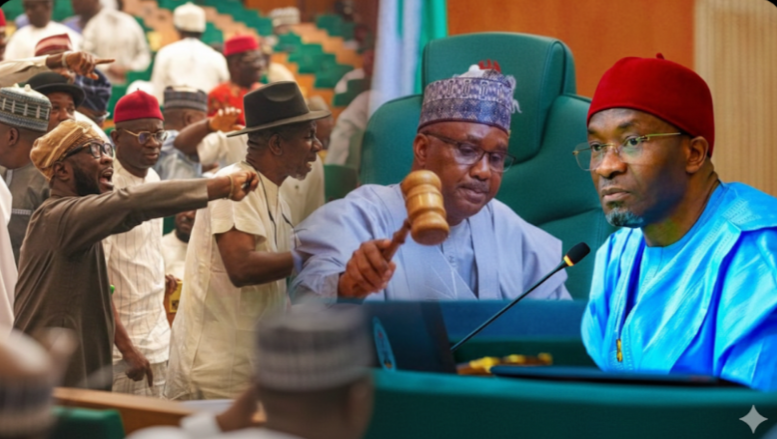
The House of Representatives was thrown into chaos on Tuesday during an emergency plenary session over the Electoral Act Amendment Bill, as lawmakers clashed openly with the leadership over the handling of the controversial legislation.
The disorder followed an attempt by Deputy Speaker Benjamin Kalu to fast-track consideration of the bill by grouping clauses together instead of reviewing them individually, as is standard parliamentary practice.
Presiding over the session, Kalu announced that lawmakers would consider “10 clauses at a time” rather than proceed clause-by-clause through the 156-clause bill.
He began approving sections in batches:
“Clause 1–10” — approved
“Clause 10–20” — approved
“Clause 20–30” — approved
This approach immediately sparked loud protests from minority lawmakers, who rose from their seats shouting:
“Clause by clause! Clause by clause!”
Several members argued they did not have copies of the harmonised bill and could not approve legislation without fully knowing its contents. Despite the uproar, Kalu reportedly continued up to Clause 65, hitting the gavel as protests intensified.
As tensions escalated and some lawmakers threatened to walk out, Kalu eventually reversed course and agreed to restart the process from Clause 1, this time considering the bill clause-by-clause.
The crisis followed earlier concerns that a joint committee scheduled to meet at 11 a.m. on February 16 to harmonise about 20 contentious clauses — including those on electronic transmission of results (Clause 60) and party primaries (Clause 84) — allegedly did not hold its meeting.
Reports indicated that instead of the formal committee session, some lawmakers from major parties met privately outside the National Assembly complex late at night to “align” ahead of the emergency plenary.
Many lawmakers later complained they had no clear understanding of the final version of the bill before debate began.
During the session, Hon. Francis Waive moved a motion seeking to rescind the earlier passage of the Electoral Act (Amendment) Bill to allow the House reconsider the legislation.
The motion was seconded by Hon. Bayo Balogun, Chairman of the Committee on Electoral Matters.
When the motion was subjected to a voice vote, lawmakers shouted “Nay” in opposition. However, Speaker Tajudeen Abbas ruled in favour of the “Ayes.”
That decision triggered fresh outrage.
Lawmakers shouted back:
“No! The Nays are louder!”
The chamber descended into shouting, confusion, and open confrontation. The session was eventually forced into a closed-door executive meeting to restore order.
Despite the rowdy proceedings, the National Assembly passed the Electoral Act, 2022 (Repeal and Re-Enactment) Bill 2026.
Here are some of the major changes:
- Electronic Transmission of Results
Electronic transmission of polling unit results will only be used if there are no network issues. Otherwise, the traditional signed result form (EC8A) will be physically transported to the collation centres.
Many Nigerians fear this could create opportunities for manipulation.
- Reduction in Election Notice Period
The Independent National Electoral Commission (INEC) will now issue election notices 300 days before an election instead of 360 days. This change is said to give flexibility in scheduling elections, including avoiding religious conflicts such as Ramadan.
- Party Primaries Reform
Indirect and consensus primaries have been abolished. Only direct primaries will now be allowed, meaning all registered party members must vote to choose their flagbearers.
Minority lawmakers described this as interference in party autonomy, arguing that political parties should decide how to select their candidates.
In the Senate, debate over mandatory electronic transmission also generated controversy. According to voting figures cited during proceedings:
55 senators voted against mandatory real-time transmission
15 voted in favour
The majority position prevailed.
Reacting to the events, former presidential candidate Peter Obi issued a strong statement condemning the tear-gassing of peaceful protesters outside the National Assembly.
He said:
“Harmless citizens performing their constitutionally guaranteed duties peacefully were tear-gassed simply for asking for what is right: free, fair, and credible elections.”
Obi accused those in power of betraying democratic principles and called on Nigerians to resist what he described as attempts to undermine electoral credibility ahead of the 2027 elections.
He insisted that real-time electronic transmission of results must be mandatory to ensure transparency.
The amended Electoral Act is expected to be transmitted to President Bola Tinubu for assent before the end of March 2026.
With the 2027 general elections approaching, the controversy surrounding electronic transmission and party primaries is likely to remain a major national issue.
The dramatic scenes in the House — marked by shouting, walkouts, and leadership reversals — highlight deep divisions within the National Assembly over the future of Nigeria’s electoral system.