


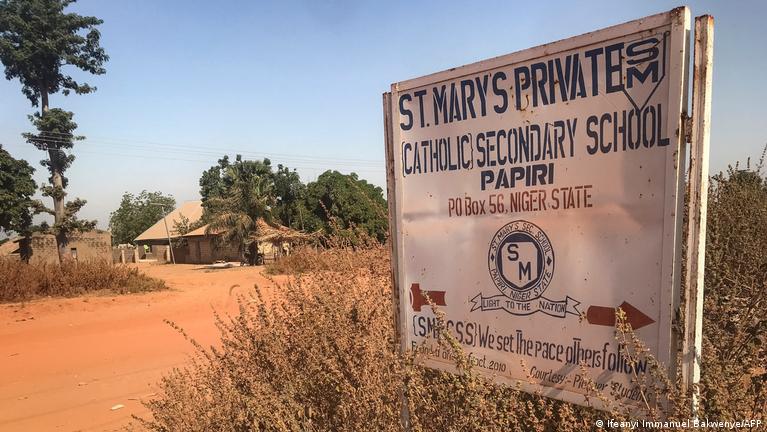
Fresh claims have emerged that the Nigerian government secretly paid a large ransom to secure the release of nearly 230 pupils and staff abducted from a Catholic boarding school in Niger State, despite official denials that any money changed hands.
Intelligence sources told AFP that the payment, described as “huge,” ran into millions of dollars and was part of a negotiated deal that also saw the release of two Boko Haram commanders. The alleged payment would contradict Nigeria’s 2022 law that criminalises ransom payments to kidnappers, with penalties of up to 15 years in prison.
According to the sources, the ransom money was transported by helicopter to Gwoza in northeastern Borno State, near the Cameroon border — an area considered a stronghold of Boko Haram. The funds were reportedly handed over to Ali Ngulde, a local militant commander. Because of poor communication networks in the remote region, Ngulde allegedly crossed into neighbouring Cameroon to confirm the money had been received before the first batch of 100 children was freed.
The abduction took place on November 21 at St. Mary’s boarding school in Papiri, central Niger State, when gunmen stormed the school and seized close to 300 students and staff. At least 50 of the victims later escaped on their own.
Although Boko Haram had not initially claimed responsibility, intelligence sources linked the attack to a feared commander known as Sadiku. He is also suspected of masterminding the 2022 gun-and-bomb assault on a passenger train travelling between Abuja and Kaduna, during which dozens of passengers — including bankers and government officials — were kidnapped and later released after ransom payments.
The St. Mary’s victims were freed after two weeks of negotiations reportedly led by National Security Adviser Nuhu Ribadu. The federal government has consistently maintained that no ransom was paid.
However, four intelligence sources familiar with the negotiations insisted that a substantial payment was made to secure the release of the children.
Estimates of the alleged ransom vary widely. One source put the total at 40 million naira, while another estimated it at as much as two billion naira. Converted to dollars, some estimates suggested the payment could be around $7 million.
Ribadu did not respond to repeated requests for comment. Nigeria’s State Security Service firmly denied paying any ransom, stating: “Government agents don’t pay ransoms.” However, a spokesperson added that private individuals are not prevented from paying to secure the release of their loved ones.
Boko Haram, which has waged an insurgency since 2009, remains most active in northeastern Nigeria. But intelligence sources say a faction operating in Niger State under Sadiku’s leadership has expanded its activities.
The children were reportedly held in a camp in Borgu Local Government Area, about 370 kilometres from Minna, the Niger State capital. Vincent Foucher, a conflict specialist at France’s National Centre for Scientific Research, said the operation fits Sadiku’s pattern.
“It makes total sense, given Sadiku’s history,” Foucher said, noting that the commander has long focused on raising funds for the group’s leadership.
The abduction happened at a time of heightened diplomatic tension. Donald Trump had previously accused Nigeria of failing to protect Christians, describing what he called “persecution” in Africa’s most populous nation.
U.S. authorities later announced that “multiple” Islamic State militants were killed in air strikes in northwest Nigeria on Christmas Day. However, Nigerian officials and analysts reject claims that the country’s security crisis is primarily religious, pointing out that most kidnap victims are Muslims.
Nigeria has struggled for years with mass abductions carried out by criminal gangs and extremist groups, sometimes working together. Despite laws banning ransom payments, kidnappings continue at alarming rates.
According to the U.S.-based Armed Conflict Location & Event Data (ACLED), 828 abductions were recorded in Nigeria over the past year, many involving multiple victims. That figure was higher than the combined totals in Mexico and Colombia. Only neighbouring Cameroon and Myanmar reported more cases.
Analysts say kidnapping has evolved into an organised and profit-driven industry. A recent report by SBM Intelligence, a Lagos-based consultancy, estimated that the crisis generated about $1.66 million between July 2024 and June 2025.
Security sources also revealed that as part of negotiations for the St. Mary’s pupils, the militants allegedly demanded that the military allow displaced residents of Audu Fari village in Borgu to return home. The village reportedly served as a supply and transit route for Sadiku’s fighters and their families.
In 2022, Nigeria passed legislation criminalising ransom payments in a bid to curb the growing wave of kidnappings. Yet many families continue to raise funds privately to secure the release of relatives, often through community contributions or online appeals.
Authorities have previously denied paying ransoms in several high-profile cases. However, security sources told AFP that payments have sometimes been made discreetly to free large groups of abductees.
For example, in December 2020, authorities in Katsina State reportedly paid 30 million naira for the release of 340 schoolboys kidnapped in Kankara town. The bandit leader Awwalun Daudawa later confirmed the payment in a leaked audio recording.
In the latest case, a state security spokesperson dismissed as “fake news” reports that ransom money was delivered by helicopter, calling the claim “laughable” and “almost unimaginable.”
But some regional analysts disagree. A security analyst in Zamfara State argued that repeated releases of high-profile victims suggest that payments are often made behind the scenes.
“There is no way bandits can keep releasing people to the government without getting payment,” the analyst said. “The government is denying what many believe to be the reality.”
Families of victims have also described situations where intermediaries, sometimes including security personnel, helped deliver ransom payments.
Abubakar Abdulkarim, a resident of Minna, said he paid $4,000 through security contacts to secure the release of his elder brother, who was kidnapped while farming in Kontagora.
For families unable to afford such sums, public fundraising has become common. In one recent case, an online appeal sought $11,400 for the release of a traditional ruler abducted on New Year’s Eve.
As Nigeria continues to battle what many now describe as a full-scale kidnapping industry, questions remain over whether the government’s public stance against ransom payments matches what happens behind closed doors.
Watch the analysis