


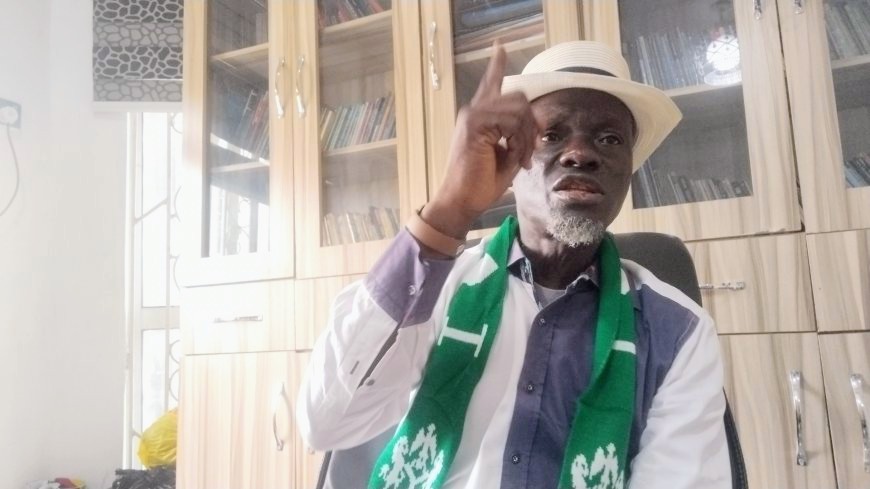
Ugolo/Osubi, Delta State — A prominent human and environmental rights activist, Comrade Mulade Sheriff, has accused the Delta State Government of failing to utilize the 13 percent oil derivation fund for the development of oil-producing communities, despite receiving the highest share of the fund among oil-producing states in Nigeria.
Mulade, who is the Ibe-Sorimowei of Ancient Gbaramatu Kingdom in Warri South-West Local Government Area, made the allegation while addressing journalists at the Africa for Peace Games Village, Ugolo/Osubi, in Okpe Local Government Area, on Sunday.
He lamented that residents of oil-bearing communities in Delta State continue to live in abject poverty, facing environmental pollution, infrastructural decay, and neglect, despite the huge revenue accruing to the state through oil derivation.
“The funds do not translate into significant development in oil-producing communities, where residents often experience environmental degradation, poor infrastructure, and neglect from government at all levels,” Mulade said.
He alleged that the hardship being faced by Deltans was made worse by the manipulation and mismanagement of the 13 percent derivation fund by those in positions of power.
“The sufferings of Deltans are aggravated by those who manipulated the 13 percent derivation to the detriment of others, especially the host communities,” he added.
According to Mulade, despite the ₦1.3 trillion received by the Delta State Government during the eight-year tenure of former Governor Ifeanyi Okowa, there is little to show in terms of development in oil-producing areas.
He noted that political interference has frustrated efforts by stakeholders to ensure accountability in the utilization of the funds, stressing that the Niger Delta region continues to suffer from massive infrastructure decay, widespread poverty, and environmental degradation.
“The 13 percent derivation funds are now used as budgetary tools by most states instead of being channeled into the development of oil-bearing communities as originally intended,” the activist stated.
Mulade also presented figures highlighting Delta State’s consistent lead in the receipt of oil derivation funds. He revealed that:
- In the first five months of 2025, Delta State received ₦185.16 billion, the highest allocation among the nine oil-producing states.
- Between June 2023 and May 2024, the state received ₦211.69 billion.
- From 2015 to 2023, Delta accounted for 29 percent of the total 13 percent oil derivation fund distributed nationwide.
Despite these large allocations, he argued that the funds have not translated into meaningful progress in oil-producing areas, accusing the state government of withholding substantial portions meant for the Delta State Oil Producing Areas Development Commission (DESOPADEC) — the agency responsible for implementing projects in host communities.
“It’s quite unfortunate that DESOPADEC currently exists only in newspapers and on paid media platforms. It has become a tool for political patronage rather than a vehicle for grassroots development,” Mulade asserted.
He recalled that the Delta State Oil Producing Areas Stakeholders Forum (DESOPASF) had recently sent an open letter to President Bola Ahmed Tinubu, making similar claims regarding the misappropriation of the 13 percent derivation fund by the state government.
Mulade therefore urged the federal and state governments to ensure transparency, accountability, and fairness in the management of oil derivation funds, noting that the purpose of the 13 percent allocation is to improve the living standards of oil-producing communities and not to serve as a political slush fund.
“The 13 percent derivation is a constitutional right meant to bring visible development to oil-bearing communities. It must not be allowed to continue as a source of wealth for a few individuals,” he said.