


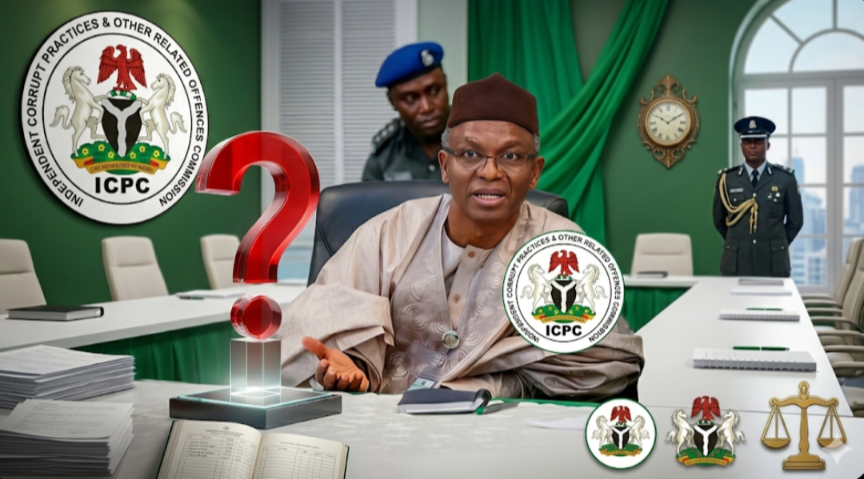
The Independent Corrupt Practices and Other Related Offences Commission (ICPC) has told a Federal Capital Territory High Court that it recovered alleged wiretapping equipment from the Abuja residence of former Kaduna State governor, Nasir El-Rufai, as part of an ongoing corruption investigation.
The commission made the claim in a sworn affidavit filed in opposition to El-Rufai’s suit challenging his detention. The case forms part of a broader probe into the management of Kaduna State finances during his tenure from 2015 to 2023, including questions over €1.4 million said to be unaccounted for and 180 suspicious payments totalling over N2.1 billion.
According to the ICPC, the alleged discovery was made during a search of El-Rufai’s residence in Asokoro, Abuja, conducted with a court-approved warrant. The agency maintained that it acted within the law and secured a 14-day remand order, which is set to expire on March 5, 2026, as investigations continue and possible charges are being prepared.
However, the former governor’s family has strongly denied the allegations, describing them as false and politically motivated. In a statement shared publicly, El-Rufai’s son dismissed the claims as a “smear campaign,” accusing the anti-graft agency of attempting to damage his father’s reputation.
His wife also rejected the allegation in clear terms, stating: “I was there. No such equipment was found. They lie.” She insisted that she personally witnessed the search and that no phone-tapping devices were recovered from the house.
In a longer family statement titled “ICPC’s Phantom Phone Tapping Equipment Allegations Against Mallam Nasir Ahmad El-Rufai and the Constitutional Right to Silence,” the family accused the commission of spreading “falsehoods and theatrical posturing.” They argued that the anti-corruption agency was engaging in a media trial rather than following due legal process.
The statement criticised what it described as attempts to undermine El-Rufai’s constitutional right to remain silent during investigations. It further alleged that the accusations were part of an orchestrated effort to tarnish his image while legal proceedings are still ongoing.
The ICPC, on its part, has maintained that its actions are based on a petition and preliminary investigations into alleged financial misconduct during El-Rufai’s time in office. The agency has insisted that it obtained relevant documents from banks and government institutions and that due process was followed in obtaining the remand order.
As the 14-day detention period approaches its expiration date, attention is now focused on whether the commission will formally file charges in court. Meanwhile, the dispute between the anti-graft agency and the former governor’s family continues to generate public debate over the allegations and the integrity of the investigation.