


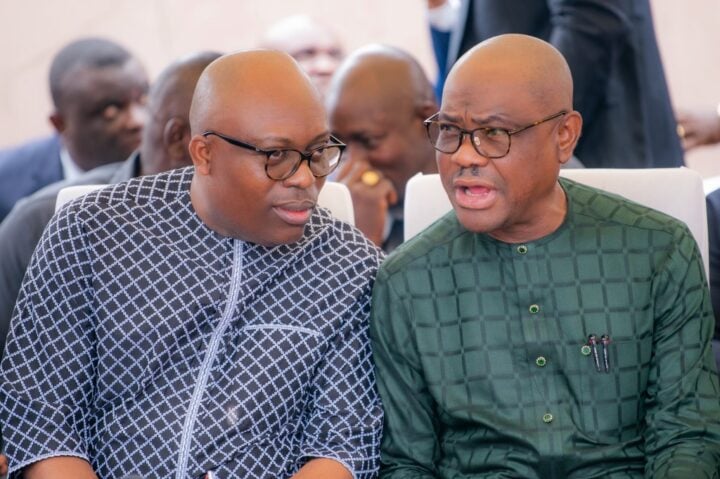
The ongoing political turmoil in Rivers State, centred around the looming impeachment of Governor Siminalayi Fubara and his deputy, Prof. Ngozi Odu, appears to be easing as both camps show signs of de-escalation. Key political figures, including former governor Nyesom Wike and Fubara, have agreed to engage in talks, offering a glimmer of hope for resolving the crisis.
Sources confirmed to Sunday Vanguard that the peace process took a positive turn after a series of meetings organised by the Pan-Niger Delta Elders Forum (PANDEF). The forum’s 7-member peace committee, headed by Chief Kanu Agabi (SAN), played a pivotal role in bringing the warring factions to the table. The committee met separately with both Wike in Abuja and Fubara in Port Harcourt last week, marking a significant step in easing the tensions that have gripped the state.
A close source revealed that, despite previous public confrontations and inflammatory statements from both sides, the meetings have yielded constructive dialogue. The committee’s efforts seem to be fostering optimism that an agreement may be reached soon. “There’s renewed hope following these talks,” said the source, adding, “Rivers people hold great respect for the committee, and we hope Nigerians will allow them to continue their work.”
The Agabi-led peace committee, formed to mediate between Wike and Fubara, has promised to submit a report within two weeks. The hope is that their efforts will resolve the political gridlock and bring an end to the deadlock that has caused significant instability in the state.
For now, it appears that the impeachment threat may not go any further. If both parties had refused to engage in these peace talks, there would have been genuine concern over the future of the state’s leadership. However, the willingness of both Wike and Fubara to cooperate has led many to believe that a peaceful resolution is on the horizon.
In a twist to the ongoing political drama, it seems that the Rivers State lawmakers, who had initially called for impeachment proceedings against the governor, may have shifted their focus to securing political guarantees for the future. Investigations revealed that many of these lawmakers, including those who previously called for Fubara’s removal, are now primarily interested in securing assurances for their re-election in 2027.
A key insider shared that the lawmakers’ demands have less to do with allegations of misconduct and more to do with securing their political futures. “There’s no real case of gross misconduct against Fubara. What they want is assurance that they will have a place in the next election cycle. Their loyalty is being tested,” the source explained.
The tension in the state traces back to December 2023, when Governor Fubara switched allegiance to the APC, a move that raised concerns among lawmakers who feared political irrelevance without guarantees for their return to the Assembly. Wike himself, the former governor, is also reportedly seeking political assurances from President Bola Tinubu, particularly regarding his continued position in the federal cabinet.
Amidst the political negotiations, a fresh legal obstacle has emerged. The APC in Rivers State has called on the state’s Chief Judge, Justice Simeon Amadi, to respect a court order that temporarily halts any actions related to the impeachment of Fubara and Odu. On Friday, the Rivers State House of Assembly forwarded a request for the Chief Judge to establish a 7-man panel to investigate the allegations against the governor and his deputy.
However, the APC has expressed strong opposition to this development, citing a court injunction that restrained the Chief Judge from acting on the Assembly’s request. The party accused the Assembly of overstepping its bounds and criticised members, including those aligned with the APC, for supporting what it termed a “choreographed legislative coup.”
The APC’s position was made clear in a statement from party spokesman Darlington Nwauju, who called on the national leadership of the APC to intervene in the situation. “We urge the National Working Committee to take immediate action to protect the party’s interests in Rivers State,” he stated.
In a show of solidarity, over 50,000 Ijaw voters from neighbouring states such as Delta, Bayelsa, Akwa Ibom, Edo, and Ondo have reportedly transferred their voting units to Rivers State in support of Governor Fubara. This strategic move is seen as a concerted effort to strengthen his position ahead of the 2026 governorship election.
The Ijaw Youth Council (IYC), led by Dr Alaye Theophilus, confirmed the shift, emphasising that the community is firmly behind Fubara due to his Ijaw roots. “We will ensure that Fubara gets a second term,” Theophilus said, adding, “No one wants to take chances on this matter.”
Similarly, the President of the Ijaw National Council (INC), Prof. Benjamin Okaba, expressed concern over the ongoing impeachment threat, calling it a betrayal of the Ijaw nation. “If Fubara is impeached, it would be a serious blow to the Ijaw community, and it would set a dangerous precedent for our democracy,” he stated.
The current political crisis in Rivers State is rooted in a deepening power struggle between Governor Fubara and his former mentor, Nyesom Wike. Despite Wike’s instrumental role in Fubara’s rise to power in 2023, their relationship soured amid disputes over control of the state, legislative cooperation, and the implementation of agreements between the two camps.
Since the fallout, the governor has faced multiple impeachment threats, culminating in the current standoff. The Rivers State House of Assembly, which is largely aligned with Wike, has attempted to initiate impeachment proceedings several times, most recently in early January 2026. Although a Rivers State High Court temporarily halted the process, the political standoff continues to strain governance in the state.
President Bola Tinubu has intervened multiple times in the crisis, even declaring a state of emergency in Rivers State in March 2025 to restore order. Although the emergency was lifted in September 2025, political tensions remain high, with no clear resolution in sight. Tinubu’s mediation efforts, however, have provided temporary truces, even as the conflict reemerges in various forms.