


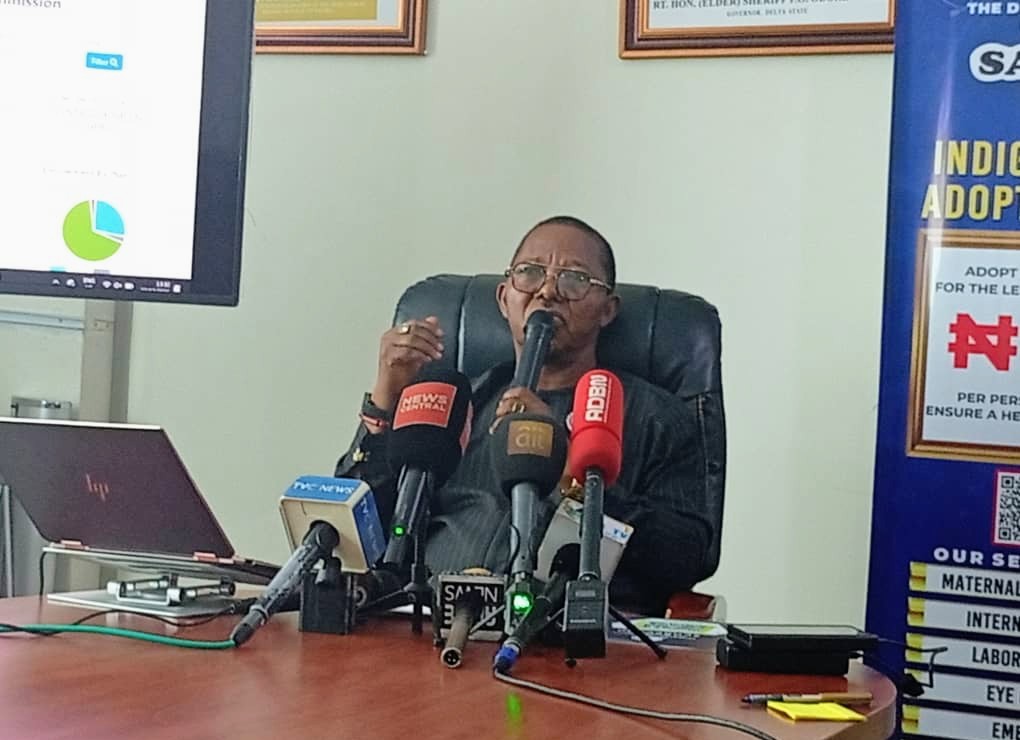
The Director-General of the Delta State Contributory Health Commission (DSCHC), Dr Isaac Akpoveta, has said the Delta State Health Insurance Scheme has recorded remarkable growth since its launch, with enrolment increasing from about 1.3 million to over 2.78 million beneficiaries across the state.
Akpoveta disclosed this while addressing journalists in Asaba, the headquarters of the commission. He attributed the success of the scheme to strong political will, sustained financial backing and consistent support from the Delta State Government under Governor Sheriff Oborevwori.
He explained that the Delta State Contributory Health Scheme was officially launched on January 1, 2017, but gained renewed momentum due to continuity in leadership, which he described as rare in public service. According to him, his retention as Director-General helped to deepen reforms, strengthen systems and ensure long-term planning.
Akpoveta revealed that Delta State currently ranks first in Nigeria in health insurance enrolment. He said while Delta has over 2.7 million enrollees, the next closest state has just above one million beneficiaries, making Delta the leading state in health insurance coverage nationwide.
He said the scheme now operates across the entire state, including rural and hard-to-reach communities where some residents had never previously accessed medical care. Through the programme, doctors and nurses have been deployed to underserved areas, improving access to healthcare for thousands of residents.
One of the commission’s major innovations, according to Akpoveta, is the deployment of over 300 Service Quality Monitors (SQMs) across major hospitals. These monitors ensure patients are attended to promptly, treated with respect and given the correct medications. He said Delta is the first state in Nigeria to introduce such a quality monitoring system within a health insurance framework.
The DG also highlighted the commission’s use of advanced digital technology to promote transparency and eliminate fraud. He explained that beneficiaries are verified through facial recognition technology before receiving treatment, ensuring that only registered enrollees benefit from the scheme. Patient encounters are also monitored in real time across health facilities.
On drug dispensing, Akpoveta said monitoring agents are stationed with doctors during consultations and at pharmacies. Prescriptions written by doctors are photographed and uploaded to the commission’s system, while drugs dispensed to patients are also documented by SQMs. If any prescribed drug is not given, the system immediately flags it and the hospital is contacted for clarification.
He added that the commission receives daily reports from health facilities, including records of treatments, surgeries and deliveries. For childbirth cases, photos of mothers and newborns are sent to the commission, followed by interviews with mothers to assess their experience and satisfaction with the care received.
Akpoveta said the performance of Service Quality Monitors is incentive-based, with higher pay awarded to those who submit more verified reports. He explained that payments to healthcare providers are also strictly tied to verified performance, noting that facilities or personnel who fail to meet required standards are not paid.
On claims and billing, the DG said the commission has fully eliminated manual submissions. Hospitals now submit bills electronically, allowing for faster processing, transparency and instant feedback, which has significantly reduced delays and abuse.
He further disclosed that special Health Insurance Units are being established in major hospitals, with dedicated doctors, clinics and pharmacies for insured patients. According to him, this initiative has greatly reduced waiting time and complaints among beneficiaries.
Akpoveta announced that pregnant women in Delta State now enjoy free antenatal care, delivery — including caesarean sections — and postnatal care under the scheme. He added that children born under the programme are covered for healthcare until the age of five at no cost to their parents.
He explained that these services fall under the Equity Health Plan, which caters for vulnerable groups such as pregnant women, children under five, the elderly, persons with disabilities and those with mental health challenges. He said the state government allocates 0.5 per cent of its annual budget to fund the plan.
On funding structure, Akpoveta said civil servants contribute 3.5 per cent of their salaries to the scheme, while workers in the organised private sector contribute five per cent. For those in the informal sector, he said the annual premium is ₦7,000.
To support residents who cannot afford the premium, the DG said the commission introduced initiatives such as the Indigenous People Early Adopters Initiative, which allows individuals, organisations and people in the diaspora to sponsor health insurance for others through a digital payment platform. He added that flexible payment options have also been introduced, allowing informal workers to make small daily payments over time.
Akpoveta noted that the scheme has contributed to a significant reduction in maternal and child mortality in Delta State and has received recognition at both national and international levels. He disclosed that Delta’s health insurance model has been presented in Rwanda and recommended by Nigeria’s National Assembly for adoption by other states.
He, however, said funding remains a major challenge and called on corporate organisations, individuals and development partners to support the scheme through corporate social responsibility initiatives.
The DG warned beneficiaries to immediately report any health worker who demands payment for services already covered under the scheme. He advised patients to insist on proper registration and follow due process, stressing that extortion would no longer be tolerated.
He said the commission has engaged relevant stakeholders and is conducting regular training sessions for health workers across the state to reinforce compliance and ethical standards.
Responding to questions from journalists, Akpoveta disclosed that about 530 healthcare facilities are currently registered with the commission, including government hospitals, teaching hospitals and federal medical centres. He added that about 88 private healthcare facilities are accredited, noting that private hospitals are only registered after meeting strict quality standards.
On future plans, he said the commission’s immediate focus is to effectively manage and fund existing services. He explained that the scheme currently prioritises common illnesses such as malaria, respiratory tract infections and pneumonia, which account for a large percentage of disease burden in the state.
According to him, while treatment of major and costly illnesses can run into millions of naira, the commission is focused on reducing preventable and common diseases. He said expansion of the benefit package would be considered once the system is fully stabilised.
Akpoveta concluded by stressing that health insurance is essential to protect families from catastrophic healthcare costs and urged residents to enrol, noting that the government alone cannot shoulder the burden of healthcare financing.